

This is a conversation that’s happening pretty much every week at investment committee. A new opportunity comes up and the trend line, at least on the revenue side, is quite clear that they’ve gone from zero to a few million in revenue, or even a few hundred thousand dollars, in rapid fashion. And, it’s usually in AI. It’s usually an impressive space. Founder’s background is legible, and in any other era this would be one that we would want to jump on as quickly as possible.
But what’s happening, and I can guarantee you this is happening in every room right now, is someone sits there and asks what’s truly unique about this, or what is this doing that other competitors are not doing. Because what’s happened with AI is there are so many competitors doing the exact same thing.
And, there’s the dreaded pause..
Michael Grinich said the exact same thing on X last week, where there will be a lot of niche companies who are gonna help with the AI transformation, and venture may not be the right funding model for them. This is one thing that internally we have given a name for, which is what I call the new valley: the five to twenty five million dollars in ARR. Or more commonly used, is this venture backable?
AI has fundamentally changed the game for software (and even some hardware) companies, where you can go from idea to revenue very quickly. That viral chart we kept seeing, everyone putting their logo on their own version of it. It just doesn’t tell us much anymore. And it’s getting crowded day by day. Every viral company that comes out has copycats in the next accelerator batch. So the stories all kinda sound the same. The why now is probably AI. It’s a large TAM. It’s a fragmented space. Lots of documents if you are in B2B.
But the more important question, which used to only happen in later stage rounds, is do we see a viable path to this company having multiple lines of revenue. Is the wedge they’ve gotten gonna lead them to adjacencies, each of which can be hundreds of millions of dollars? Or alternatively is their primary product large enough to make hundreds of millions of dollars (e.g. coding agents). Not every feature deserves to be its own company, and the ambition has to be worth the ten year journey. And, we have to decide on this with twelve (or sometimes six) months of data. That’s very, very hard to get right. But hey, that’s the job, as Dempsey would say.
Historically, there have been only two types of companies that have worked. One is the extremely fast, hype driven, blue ocean, massive global change like covid, remote work, or AI (no triple triple double double here). The other one is typically more measured, incremental even. The playbooks for how you run these companies are very different. The hype one is more land grab: underprice the competition, spend a lot, raise many rounds of funding. The incremental one is more figure out the details: customer loyalty, negative churn, one or two rounds, then profitable and fast growth.
Right now at the seed stage, every company is getting priced like it’s on the fast path. The fast story is the only one the market will pay for, and that’s the story founders want to tell. Collectively, we know that most of these companies are gonna be on the slow path, but nobody knows which one breaks out at the seed stage.
So that company we talked about at the start may not get funded. It may not die either. It just gets stuck, where what made you legible at the seed is now becoming the bar even at the later rounds. And, what’s painful especially from a founder’s perspective, is these companies ARE good. Customers are great, margins are good, founders are good. A lot of them are in unsexy markets where in the long term they might become amazing businesses. But the Series A squeeze IS happening and the middle is shrinking out. Carta found only 15.4% of Q1 2022 seed companies reached a Series A within two years. The 2018 cohort was 30.6%. This, in my view, will get worse every quarter.
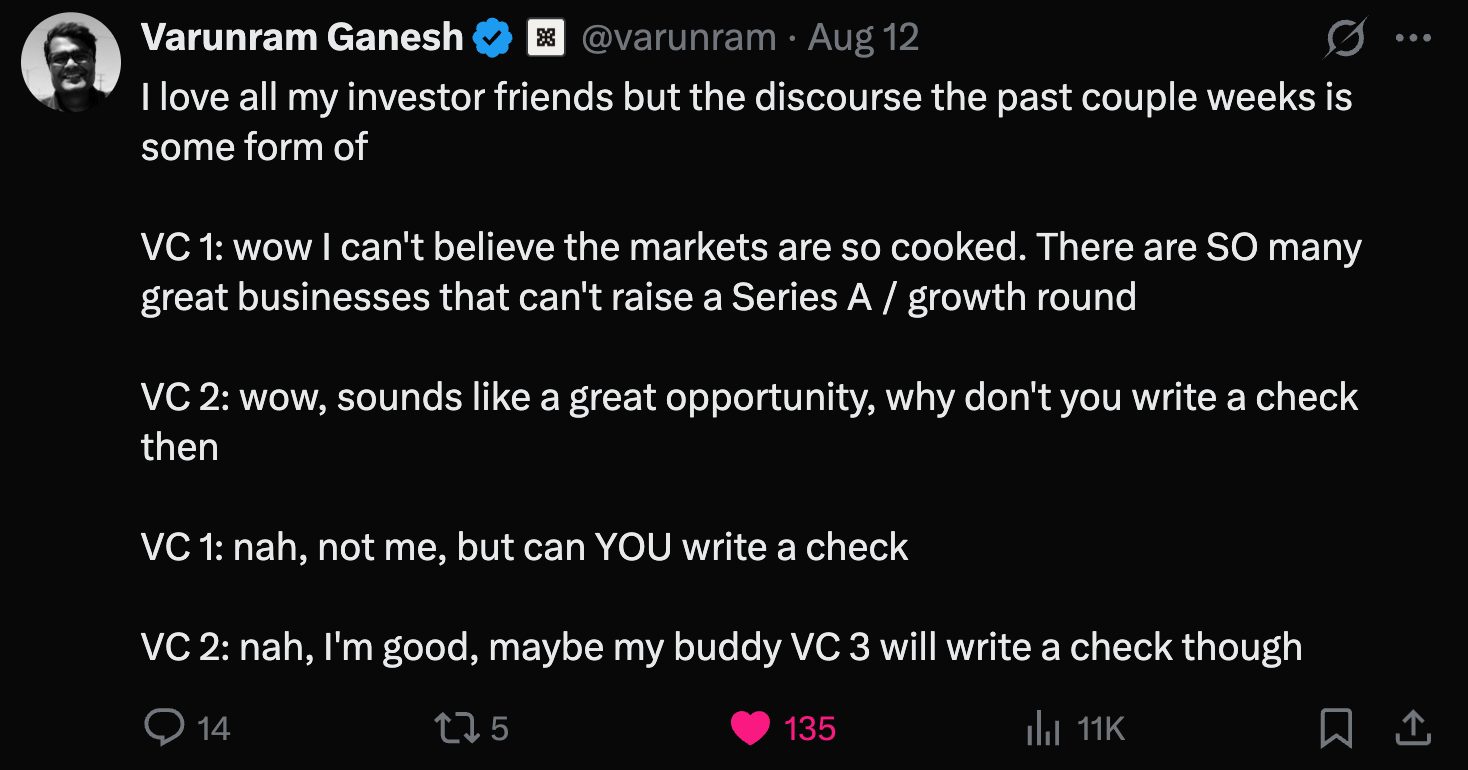
Varunram nails how this discourse usually ends..
So what options do these companies have? There are three or four paths they can go down.
The first one is obviously a second act. Go back to showing a path towards how do you get to hundreds of millions of revenue from the first product. Some founders genuinely have it in them, and figuring out if you’re one of them is what the next two years of board meetings are about.
Second is M&A, which is happening a lot. Right now every incumbent needs an AI transformation. Salesforce, Workday, Meta are all acquiring companies. But they are primarily acquiring you for the talent, even though it’s an acquisition. It’s not the revenue. You spend four years building an $8M business and the acquirer values everything about it except the revenue.
Third is you stay. You kind of keep chugging along, build a good valuable company, and maybe potentially buy back the stock. Find alternative capital sources that allow you to enable the growth.
And the fourth, which is you take the bitter pill upfront. There’s a new generation of founders that are seeing this issue and opting out of the venture treadmill altogether, where essentially they seed-strap. Raise a little bit of money from friends and family, get profitable almost immediately, keep eighty+ percent of the company. And they are very open with investors that they’re never gonna raise again. They are the only honest people in this story. They still are able to find a way, even though for investors it may not be one of those truly venture backable companies.
And that’s the problem right now with the new valley. There’s a lot of new good companies, and these kind of good companies are everywhere now. But, venture capital is an outlier spotting business. Few companies return the entire fund and the other companies round to ~zero. And, founders know this math when they take our money. That was the deal. I don’t think there is a systemic fix for this from a capital perspective. Every year someone proposes something that’s more dividend like, where you pay the money back. Michael’s version was more like an SBIR for AI enablement. Indie.vc and Earnest Capital were the dividend like ones. Founders liked it, but LPs balked, because a capped dividend doesn’t fit any bucket they are currently set up to buy. The idea keeps dying on the capital side. Maybe this time could be different, but I don’t think so.
So going back to the investment committee meeting. When we see a unique insight, large ambition, a founder who’s found a path that’s unique, we lean in aggressively. Outliers never look obvious at first.
But there will be a lot of companies in the middle, good but not great, that we end up having to unfortunately decline. I can see a lot of other partnerships doing the same thing. And I don’t have a good answer for what happens to all of them. I’m not sure anyone does yet.
Thanks to Michael, Jake, Ethan, Joowon, Vishnu and others for reading drafts and providing edits!
AI turned early traction into the pilot and Series A into the franchise meeting
I think paths 3 and 1 can and arguably should be concurrent. Chugging along, running a near breakeven/profitable business while figuring out a second act. It's using Product 1 as the cash cow to keep the lights on, and the remaining VC dollars raised as R&D fuel for Act 2.