

I was helping a friend with his hiring plan. The second role on his doc was head of growth. He had built a great product with some early users but no real distribution, and he asked if I could intro anyone good. I told him he was the head of growth until he could tell me who his actual customer was.
At his last job there was a team of twenty handling this stuff, and most of the growth came from pushing notifications to a billion users who already had the app installed. He’d spent nine years inside that machine. It hadn’t really occurred to him that distribution was now something he personally had to figure out. You could hear it land on the call.
I posted this on X a few days later:
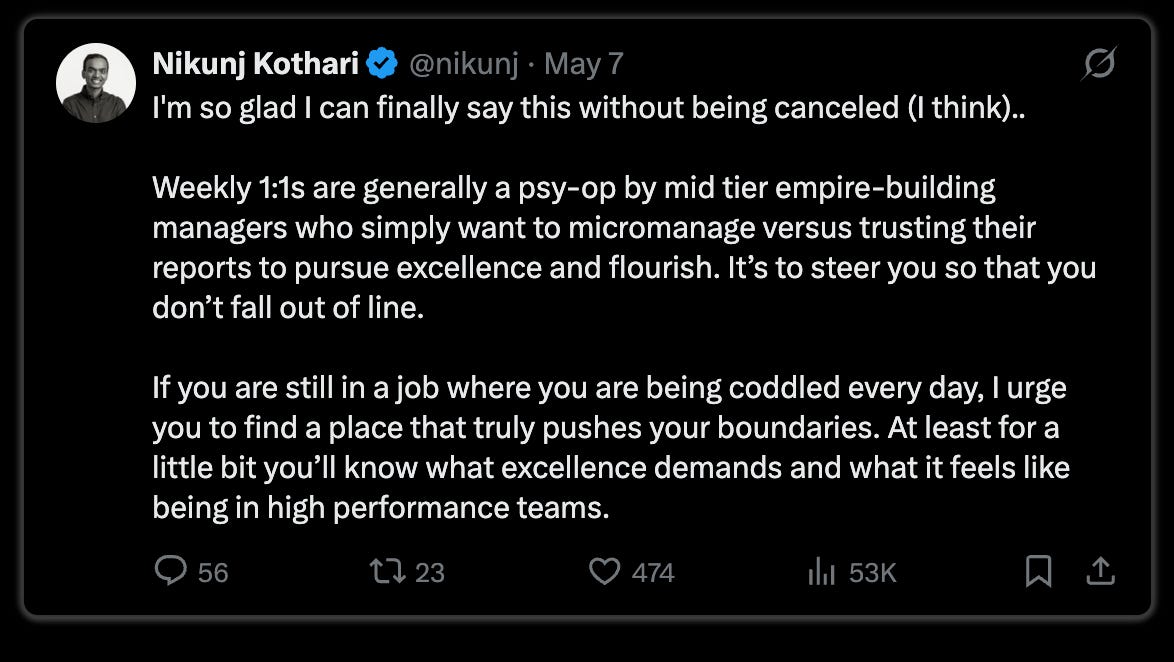
Every big-company manager replied to tell me I knew nothing and that this is how it’s always been done. The startup managers replied the other way, saying yes, finally, somebody said it out loud.
I left LinkedIn ten years ago for basically the same reason, except I didn’t have any words for it back then. I just had this itch I couldn’t have explained to anyone if they’d asked. The vesting was good and the lunches were free and my manager was someone I genuinely liked and I never canceled a 1:1. Underneath all of that, there was this autopilot I’d somehow convinced myself was just how I happened to be wired. It took me a decade and a few failed startups and probably a hundred founder calls before I could land on what the word actually was.
Back to the 1:1s for a second. They actually started for a real reason, which is that Andy Grove was running Intel in the seventies and the chip market would kill you if you got a single quarter wrong. He needed his managers making sharp calls fast with information from the people closest to the actual work. The 1:1 was a leverage tool for the manager and a communication channel for the company. Forty years of broken telephone later, it’s mostly turned into a wellness check where the manager performs some amount of concern and the report shows up with a pre-written agenda from the night before, and both of them walk out feeling like they did something even though neither of them actually did anything that mattered.
Once you start seeing this pattern in the 1:1, you start seeing it everywhere else too. Google’s free food was a recruiting weapon back when the engineer war was getting nasty, and it was also designed to keep you in the office a few hours longer than you would have stayed otherwise. OKRs were how you focused a giant organization around a few real bets that the leadership team had picked. Stock comp was supposed to align you with outcomes the company hadn’t actually earned yet, on a four-year vesting cliff that conveniently kept you in your seat. Promo packets were supposed to keep managers from just promoting their friends and giving raises to whoever happened to be in the room. Every one of these solved something real at the time they were introduced. None of them were ever supposed to become a thing you were owed for showing up.
But that’s exactly what happened. An entire generation of tech workers came up believing the apparatus they walked into was the bare minimum any reasonable employer would provide, when it was really just a recruiting offer that nobody ever bothered to take back once they’d hired you. We built daycares for adults.
You don’t learn agency in a place that never asks you to have any. And ownership is the same kind of problem, in that you can’t really learn how to do it when there’s always somebody else around to do it for you. You learn it the first time you realize nobody is going to push a notification to a billion users to make your problem go away. You’re the only person in the building who can actually fix what’s broken.
You might be reading this and shrugging it off because it doesn’t seem to apply to you. You’re in a big company and you’re comfortable and the paycheck keeps showing up like clockwork. Maybe your manager really does care about you, and maybe the company really is organized in a way that lets the best ideas win. There’s only one way to actually find out for sure. Pick something a customer actually wants and chase it down without writing a doc or booking a kickoff or sticking it in your OKRs anywhere. Then watch carefully to see who in the room congratulates you for helping a customer and who reprimands you for skipping the process. That’s how you find out.
Well said!
A year into the pandemic, I decided to leave tech to work at a manufacturing startup in Delhi, India that needed to grow while showing profits every year.
One of the most instructive experiences of my life. Prior to this I had run my own tech startup mostly out of posh co-working spaces in Bangalore and prior to that worked at a heavily funded tech company with catered meals and live food counters.
The manufacturing company’s head office (in a remote non-descript industrial area outside Delhi) did not even have a properly functioning AC. Every penny mattered. And it was simply the case that managing working capital and buying equipments for our tiny prototype plant was more important than the slight discomfort of not having a casette AC.
If you’re a mid to upper-mid level exec in tech you don’t ever hear of working capital cycles or depreciation. Those things come much later.
But if you’re in manufacturing every penny matters. It’s quite remarkable how much I had to unlearn and re-learn.